 Institute of Computer Science
- Institute
- People
- Research
- Applications
- Events
- Library
- Jobs
Department of Statistical Modelling and Artificial Intelligence
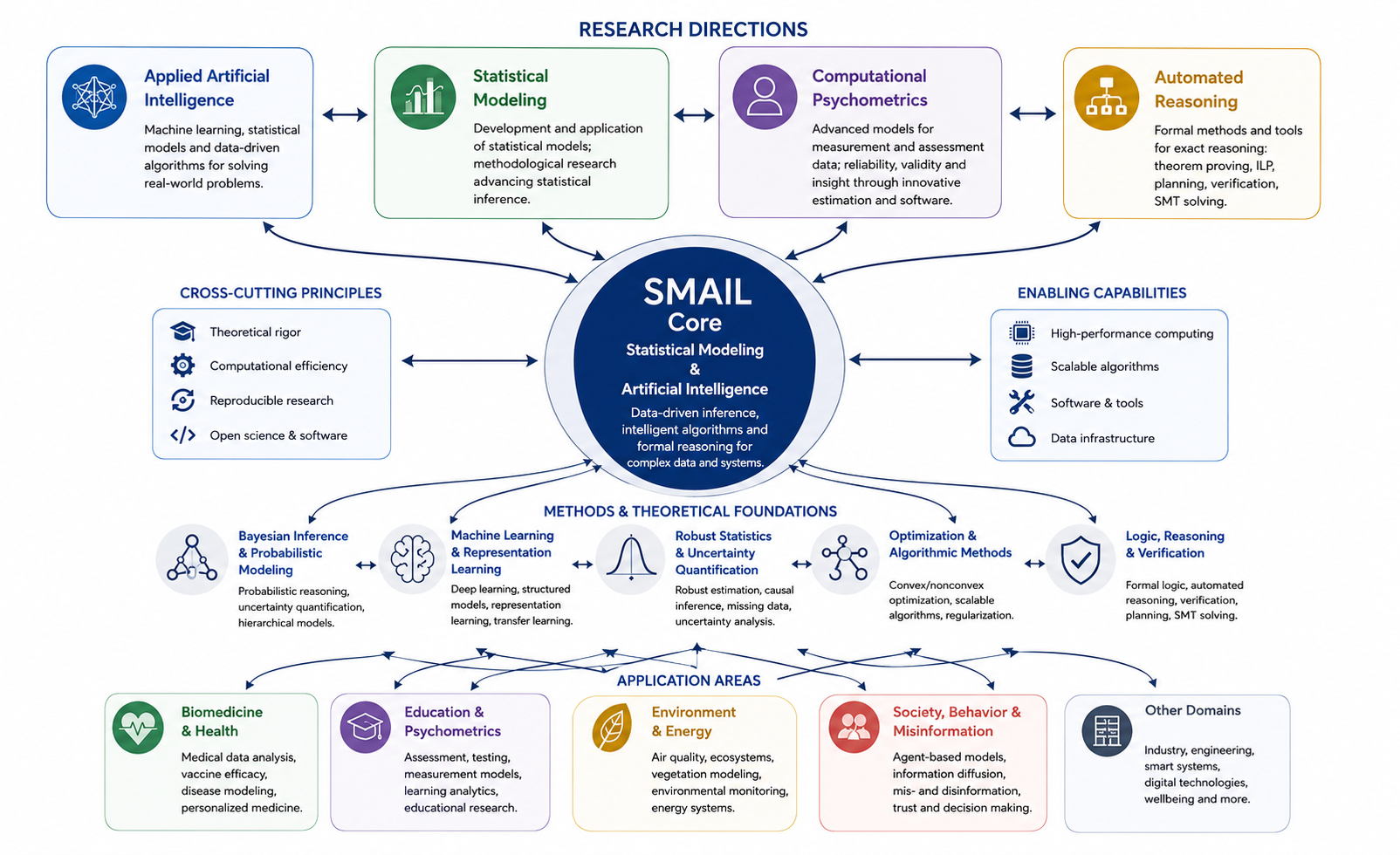
Department of Statistical Modeling and Artificial Intelligence (SMAIL) develops advanced computational, artificial intelligence, and statistical methods for the analysis and understanding of complex data. Our research combines computer science, machine learning, algorithmic approaches, and statistical modeling to address challenging scientific and technological problems.
We study the theoretical foundations of artificial intelligence and statistics, design innovative models, develop efficient estimation and learning algorithms, and implement new methods in scientific software. Our research is grounded in rigorous theoretical foundations and evaluated through simulation studies and real-world applications. Methodologically, we strive for scientific excellence, developing approaches that advance the state of knowledge in statistical modeling, artificial intelligence, and data-driven computation. Particular attention is devoted to principled statistical reasoning, reliable data-driven decision making, and the integration of diverse sources of information using both frequentist and Bayesian frameworks.
We have extensive experience in applying artificial intelligence methods and analyzing real-world data using statistical approaches across diverse domains. Our approaches are used in areas including social sciences and psychometrics, biomedical research, environmental and energy systems, and other fields where advanced data analysis and intelligent algorithms play a key role.
Work Groups
- Applied Artificial Intelligence: This group primarily focuses on developing and advancing AI methods, while also applying them to real-world problems, integrating machine learning, statistical modeling, and data-driven algorithms.
- Automated Reasoning: This group develops tools that allow computers to reason in a mathematically precise way, which is indispensable for the reliable design of automated systems. To this end, the group advances the state of the art in fields such as proof assistants, inductive logic programming, planning, formal verification, and SMT solvers.
- Computational Psychometrics: This group focuses on developing advanced computational and statistical models for analysing ratings and measurement data in education, psychology, and the social sciences, with an emphasis on reliability, validity, and extracting detailed insights through novel estimation methods and reproducible software tools.
- Statistical Modeling: This group focuses on developing and applying statistical models to real-world, interdisciplinary problems, while also conducting methodological research to advance statistical methodology.
Projects
- Modeling the Spread of Mis- and Disinformation: An Agent-Based Model TQ23000183 (2025 - 2028)
- Innovative AI Agent with Animated Avatar for Interaction with Web Applications FY01010144 (2025 - 2027)
- Biography of Fake News with a Touch of AI: Dangerous Phenomenon through the Prism of Modern Human Sciences (Dezinfo) EH23_025/0008724 (2025 - 2028)
- Knowledge in the Age of Distrust (TRUST) EH23_025/0008711 (2025 - 2028)
- Complex analysis of educational measurement data to understand cognitive demands of assessment tasks GA25-16951S (2025 - 2027)
- Research of Excellence on Digital Technologies and Wellbeing EH22_008/0004583 (2024 - 2028)
- Potential replacement vegetation modelling for nature conservation (NaPoVeg) SS07020042 (2024 - 2026)
- Air quality Research, Assessment and Monitoring Integrated System (ARAMIS) SS02030031 (2020 - 2026)
Selected publications
- Cerna, D.M., Buran, M.One or nothing: Anti-unification over the simply-typed lambda calculus. ACM Transactions on Computational Logic 25, 16 (2024).
- Fejlek, J., Ratschan, S. Computation of feedback control laws based on switched tracking of demonstrations. European Journal of Control 80, Part B, 101118 (2024).
- Kůrková, V., Sanguineti, M.Approximation of classifiers by deep perceptron networks. Neural Networks 165, 654-661 (2023).
- Figueroa-Garcia, J.C., Neruda, R., Hernandez–Pérez, G.A genetic algorithm for multivariate missing data imputation.Information Sciences 619, 947-967 (2023).
- Dudášová, J., Valenta, Z., Sachs, J. R.Improving precision of vaccine efficacy evaluation using immune correlate data in time-to-event models. npj Vaccines 9, 214 (2024).
- Kalina, J., Kukal, J., Vyšata, O.A novel class of rank tests for high-dimensional data with an application to Alzheimer's disease. Biocybernetics and Biomedical Engineering 45, 707-717 (2025).
- Martinková, P., Hladká, A.Computational aspects of psychometric methods with R. CRC Press (Taylor & Francis Group, LLC), Boca Raton (2023).
- Hladká, A., Martinková, P., Magis, D.Combining item purification and multiple comparison adjustment methods in detection of differential item functioning. Multivariate Behavioral Research 59, 46-61 (2024).
Department Members
Core researchers
Project staff
- David M. Cerna
- Michaela Cichrová (PhD. student)
- David Coufal
- David Černý
- Jana Dlouhá
- Kristýna Dvořáková
- Zdeněk Fabián
- Adéla Hladká
- Jan Klaschka
- Robin Kopecký
- Matyáš Lorenc (PhD. student)
- Ivana Malá
- Ondřej Neruda
- Jan Netík (PhD. student)
- Anggha Nugraha
- Ján Pavlech
- Ladislav Pecen
- Iván Leonardo Pérez Cabrera (PhD. student)
- Jiří Šejnoha
- Lubomír Štěpánek
- Marie Turčičová
- Michaela Vařejková (PhD. student)
- Petra Vidnerová
- Jun Wu
- MD Khadimul Islam Zim (PhD. student)
Head: Jan Kalina
Address
Institute of Computer Science
Pod Vodárenskou věží 271/2
182 00 Praha 8


