Seminar in Psychometrics
On Identifiability and Estimation of Partial-Mastery Cognitive Diagnosis Model
Speaker: Jun Wu, Department of Statistical Modeling, Institute of Computer Science
Date and time: Thursday, April 16, 2026 (16:00 PM CET)
Place ICS CAS room 318, Pod Vodárenskou věží 2, Prague 8, also on Zoom.
Zoom: 949 6153 1717, passcode: 646735.
Partial mastery (PM) cognitive diagnostic models (CDMs) (Shang et al., 2021) extend traditional CDMs by allowing latent attribute mastery to be continuous rather than binary. In PM-CDMs, each subject is characterized by a fixed continuous mastery score vector of multidimensional latent attributes, instead of a binary mastery indicator vector as in traditional CDMs. For each item, an item-specific binary vector is generated from the continuous mastery score vector, representing the attributes are effectively activated when responding to that item. First, we discuss the connection between PM-CDMs and both compensatory and non-compensatory item response theory (IRT) models, and relate them to recent developments on generalized additive PM models. Despite growing interest in PM-CDMs, their identifiability properties have not yet been formally established. We provide the first systematic study of identifiability for partial mastery deterministic input noisy “and” gate (PM-DINA) models. We derive sufficient conditions for identifiability that are directly analogous to known results for traditional CDMs. In addition to theoretical results, we investigate practical estimation of PM-DINA models through a computational study. We evaluate and compare the feasibility, accuracy, and computational efficiency of several estimation methods. Our results suggest that Markov Chain Monte Carlo (MCMC) provides reliable and accurate estimation, while stochastic approximation mirror descent (SA-MD) are more scalable and efficient while maintaining acceptable accuracy. This is a joint work with Patricia Martinkova and Elena Erosheva.
References:Shang, Z., Erosheva, E., Xu, G. (2021). Partial-Mastery Cognitive Diagnosis Models". The Annals of Applied Statistics. Vol. 15, No. 3., 1529-1555. https://projecteuclid.org/journals/annals-of-applied-statistics/volume-15/issue-3/Partial-mastery-cognitive-diagnosis-models/10.1214/21-AOAS1439.pdf
Fang, G., Guo, J., Xu, X., Ying, Z., and Zhang, S. (2021) Identifiability of bifactor models. Statistica Sinica, Vol. 31, 2309-2330 https://www.jstor.org/stable/27089277
Wallmark, J. (2024). IRTorch: Item response theory with Python. https://github.com/joakimwallmark/irtorch
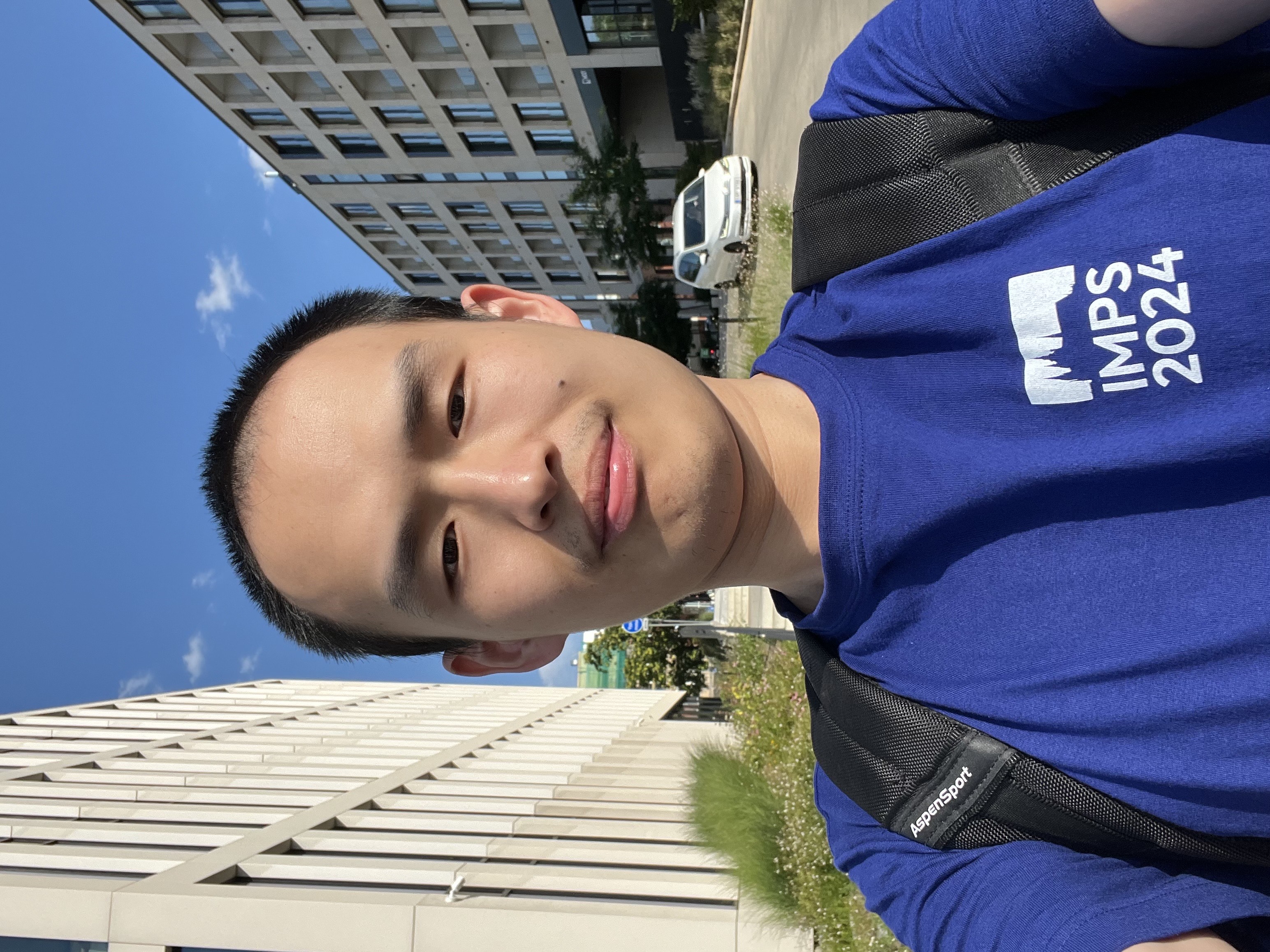
Jun Wu
Jun Wu is a postdoctoral researcher at Institute of Computer Science (ICS), Czech Academy of Sciences. His research focuses on theoretical foundations of graphical models and latent variable models. Having a background in mathematics and statistics, he is interested in applying algebraic tools and statistical methods to psychometric problems such as cognitive diagnostic models. Before joining ICS, he obtained his doctoral degree in the Chair of Mathematical Statistics (Prof. Mathias Drton) at Technical University of Munich.