 Main Index
 Mathematical Analysis
Special Functions
Mathematical Analysis
Special Functions
 Subject Index
 comment on the page
Main Index
Mathematical Analysis
Special Functions
Subject Index
comment on the page
Euler Beta function or Euler function of the first kind  (this name was introduced by Legendre) is defined by the integral
![B(a, b) = Underoverscript[∫, 0, arg3] x^(a - 1)(1 - x)^(b - 1) d x](HTMLFiles/BetaFunction_1.gif) | (1) |
which converges if and only if  ,
,  .
.
To compute values of  go to
go to  .
.
The graph of Beta function
![[Graphics:HTMLFiles/BetaFunction_5.gif]](HTMLFiles/BetaFunction_5.gif)
Substitution  immediately gives that
 | (2) |
Integration by parts in Equation 1 yields

and consequently
 | (3) |
where the last equation is a consequence the symmetry relation Equation 2.
If  is a positive integer then Equation 3 implies

Since  ,
,
 | (4) |
where  is the Pochhammer symbol . Thus if both
  and
and  are positive integers, then
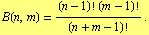 | (5) |
Another expression for Beta function we get using the substitution  in Equation 1
![B(a, b) = Underoverscript[∫, 0, arg3] y^(a - 1)/(1 + y)^(a + b) d y = 2 Underoverscript[∫, 0, arg3] y^(2 a - 1)/(1 + y^2)^(a + b) d y .](HTMLFiles/BetaFunction_21.gif) | (6) |
If  then the substitution
  in first integral of Equation 6 gives
![B(a, 1 - a) = Underoverscript[∫, 0, arg3] y^(a - 1)/(1 + y) d y = π/(sin πa) ... sp; 0 < a < 1.](HTMLFiles/BetaFunction_24.gif) | (7) |
In particular
 | (8) |
From Equation 6 there follows
![B(a, b) Γ(a + b) = Underoverscript[∫, 0, arg3] (Γ(a + b) y^(a - 1))/(1 + y)^(a ... 7;, 0, arg3] e^(-x) x^(b - 1) d x Underoverscript[∫, 0, arg3] e^(-x y)(x y)^(a - 1) d (xy),](HTMLFiles/BetaFunction_26.gif)
what gives an extension of Equation 5 to non-integral values of arguments
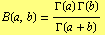 | (9) |
This can be also proved using Laplace transform [1] . We have
 | (10) |
Using the convolution integral and the substitution  we obtain
![Γ(p) s^(-p) Γ(q) s^(-q) = L {Underoverscript[∫, 0, arg3] τ^(p - 1)(t - &ta ... - 1) Underoverscript[∫, 0, arg3] x^(p - 1)(1 - x)^(q - 1) d x} = L {t^(p + q - 1) B(p, q)} .](HTMLFiles/BetaFunction_30.gif)
Equation 10 shows that  for
for  and
and  , and Equation 9 is again proved.
We also have
![B(a, b) = 1/a Underoverscript[∑, k = 0, arg3] (-1)^k (b(b - 1) ...(b - k))/(k ! (a + k)), b > 0,](HTMLFiles/BetaFunction_34.gif) | (11) |
![B(a, b) = Underoverscript[∏, k = 0, arg3] k(a + b + k)/((a + k) (b + k)),](HTMLFiles/BetaFunction_35.gif) | (12) |
![B(a, b) = 2 Underoverscript[∫, 0, arg3] sin^(2 a - 1) φ cos^(2 b - 1) φ d φ,](HTMLFiles/BetaFunction_36.gif) | (13) |
![B(a, b) = 2 Underoverscript[∫, 0, arg3] sin^(2 a ) φ cos^(2 b) φ d φ , &n ... a > -1/2, b > -1/2,](HTMLFiles/BetaFunction_37.gif) | (14) |
![B(a, b) = Underoverscript[∫, 0, arg3] (x^(a - 1) + x^(b - 1))/(1 + x)^(a + b) d x, a > 0, b > 0,](HTMLFiles/BetaFunction_38.gif) | (15) |
![B(a, a) = 1/2^(2 n - 1) Underoverscript[∫, 0, arg3] (1 - x)^(a - 1)/x^(1/2) d x .](HTMLFiles/BetaFunction_39.gif) | (16) |
| [1] | Brown, J. W. (1961, Feb.). The Beta-Gamma Function Identity. Amer. Math. Monthly, 68, 165. |
Cite this web-page as:
Štefan Porubský: Beta Function.