 Main Index
 Number Theory
Arithmetics
Multiplication
Divisibility
Number Theory
Arithmetics
Multiplication
Divisibility
 Subject Index
 comment on the page
Main Index
Number Theory
Arithmetics
Multiplication
Divisibility
Subject Index
comment on the page
In 1808 Legendre [1] , p. 10,  (
) showed that
(
) showed that
Theorem. The exact power  of a prime
  dividing
  ,
,  , is
, is
![e _ p(n !) = ⌊ n/p ⌋ + ⌊ n/p^2 ⌋ + ⌊ n/p^3 ⌋ + ... = Underscript[∑, i] ⌊ n/p^i ⌋](HTMLFiles/PrimePowerDividingFactorial_5.gif) | (1) |
where  denotes the integer part function and the sum is finite containing
  terms, where
  is the largest power of
  dividing
  , i.e.
  but
but  .
.
The proof is simple. We can suppose that  . The value
  counts the number of multiples of
  less or equal to
  . Thus there are
  positive integers
  with
with  being the exact power of
  dividing each. So the power of
  dividing
  equals
![Underoverscript[∑, i = 1, arg3] i ( ⌊ n/p^i ⌋ - ⌊ n/p^(i + 1) ⌋ ) = Underoverscript[∑, i = 1, arg3] ⌊ n/p^i ⌋ .](HTMLFiles/PrimePowerDividingFactorial_23.gif)
Corollary 1 (Legendre). Let  be a prime and
  is the base-
 expansion of
  . Then
![e _ p(n !) = (n - Underoverscript[∑, i = 1, arg3] a _ i)/(p - 1) .](HTMLFiles/PrimePowerDividingFactorial_28.gif) | (2) |
Proof. If  , then
  ,
,  , and the result holds. Let
  . If
. If  , then
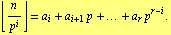
Then
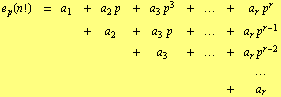
Adding columnwise we get

Corollary 2 (Čebyšev identity). If  then
then
![Underscript[∑, n <= x] ln n = ln ⌊ x ⌋ != Underscript[∑, p <= x] ln p ( ⌊ n/p ⌋ + ⌊ n/p^2 ⌋ + ⌊ n/p^3 ⌋ + ...),](HTMLFiles/PrimePowerDividingFactorial_38.gif) | (3) |
Corollary 3. The series  diverges (p runs over all primes).
Proof. There follows from (2) that  and consequently
![n ! < Underscript[∏, p <= n] p^n/(p - 1)](HTMLFiles/PrimePowerDividingFactorial_41.gif)
or that
![n !^(1/n) < Underscript[∏, p <= n] p^1/(p - 1) .](HTMLFiles/PrimePowerDividingFactorial_42.gif)
Then
![ln n !^(1/n) < Underscript[∑, p <= n] (ln p)/(p - 1) <= 2 Underscript[∑, p] (ln p)/p .](HTMLFiles/PrimePowerDividingFactorial_43.gif)
Since  , the result follows.
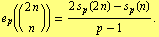
Corollary 4. If  denotes the sums of digits function in base
  then
then
| [1] | Legendre, A. M. (1808). Essai sur la theorie des nombres (2ed.). Paris. |
Cite this web-page as:
Štefan Porubský: Prime power dividing a factorial.