 Main Index
 Mathematical Analysis
Mathematical Constants
Mathematical Analysis
Mathematical Constants
 Subject Index
 comment on the page
Main Index
Mathematical Analysis
Mathematical Constants
Subject Index
comment on the page
It is defined as
![FormBox[RowBox[{γ, , =, RowBox[{Underscript[lim, n -> ∞] (Underov ... 1/k - ln n), =, RowBox[{0.577, , 215, , 664, , 901, , 533, ..., Cell[]}]}]}], TraditionalForm]](HTMLFiles/EulerMascheroni_1.gif) | (1) |
The existence of the limit follows from the integral test for the convergence of series  .
.
To compute  with higher precision got to
  .
.
We also have integral representations
![γ = Underoverscript[∫, 1, arg3] (1/⌊ x ⌋ - 1/x) d x,](HTMLFiles/EulerMascheroni_3.gif) | (2) |
another one is

In 1836 Dirichlet [1] gave the following integral represenantion of 
![γ = Underoverscript[∫, 0, arg3] (-1/(1 + t) - 1/e^t) 1/t d t .](HTMLFiles/EulerMascheroni_6.gif)
He aslo proved that
![γ = Underscript[lim, p -> 0 +] (Underoverscript[∑, n = 1, arg3] 1/n^(1 + p) - 1/p) .](HTMLFiles/EulerMascheroni_7.gif)
The constant was first defined by Euler [2] () [3] . Euler denoted it by  , the notation
  was introduced by Mascheroni (1790).
The evaluation of γ is not easy. The limit defining  converges very slowly.
![[Graphics:HTMLFiles/EulerMascheroni_11.gif]](HTMLFiles/EulerMascheroni_11.gif)
Young proved that
![1/(2 (n + 1)) < Underoverscript[∑, k = 1, arg3] 1/k - ln n - γ < 1/(2 n)](HTMLFiles/EulerMascheroni_13.gif)
and thus
![Underoverscript[∑, k = 1, arg3] 1/k - ln n - γ ~ 1/(2 n) .](HTMLFiles/EulerMascheroni_14.gif)
![[Graphics:HTMLFiles/EulerMascheroni_15.gif]](HTMLFiles/EulerMascheroni_15.gif)
Even with 4500 terms, this approximation using the definition is only good to three decimal places (despite the impression induced by the graphs above)
![Underoverscript[∑, k = 1, arg3] 1/k - ln 4500 - γ = 0.000 111 107 ...](HTMLFiles/EulerMascheroni_17.gif)
To experiment with  go to .
Euler initially calculated the value of  to 6 decimal places. In 1736 he computed
  to 15 decimal digits correctly using a more rapidly convergent expression (a special case of the so-called Euler-Maclaurin summation)
![Underoverscript[∑, k = 1, arg3] 1/k - ln n - 1/(2 n) + 1/(12 n^2) - 1/(120 n^4)](HTMLFiles/EulerMascheroni_21.gif)
Here
![Underoverscript[∑, k = 1, arg3] 1/k - ln n - 1/(2 n) + 1/(12 n^2) - 1/(120 n^4) ~ -1/(252 n^6) .](HTMLFiles/EulerMascheroni_22.gif)
More precisely, Euler used his summation formula that
 | (3) |
where  are Bernoulli numbers (in the old odd notation) given by the generating function
  . Thus
  ,
,  ,
,  ,
,  . Note that the series on the right hand side is not convergent but due to fact that it is an alternating one the computation error at any stage is less than the next term in the series. Euler found that
  with
with  and
and  . Gauß later extended this by the next quadruple of digits 6060. With
  and
and  in (3) astronomer John Couch Adams (1815-1908) calculated
  to 236 places [4] . This required a knowledge of Bernoulli numbers
  which he previously tabulated (Actually the first 31 Bernoulli numbers were previously computed by M.Ohm [5] , Adams computed 31 following ones using von Staudt theorem).
To experiment with  go to .
In 1790 Mascheroni [6] calculated its 32 decimal places, from which only the first 19 decimal places were correct (for more details visit ).
In 1962 D.E.Knuth obtained 1271 digits of γ also using Euler-Maclaurin summation. The next year Sweeney [7] computed 3683 digits using an expansion of the exponential integral Ei(x). Sweeney used a formula already known to Euler
![Underoverscript[∑, k = 1, arg3] ((-1)^(k - 1) x^k)/(k ! k) - log x - γ = Underoverscript[∫, x, arg3] e^(-t)/t d t = O(e^(-x)/x) .](HTMLFiles/EulerMascheroni_39.gif)
In 1980 Brent and McMillan [8] computed 30100 digits using identities involving modified Bessel functions in about 20 hours computer time on Univac 1100/42. They showed that
![(Underoverscript[∑, k = 0, arg3] H _ k · (x^k/k !)^n)/(Underoverscript[∑, k ... bsp; as x -> ∞ ,](HTMLFiles/EulerMascheroni_40.gif)
where  is the
  th harmonic number, and

They used this formula with  They also calculated the first 29200 partial quotients in the regular continued fraction expansion for γ and proved that if Euler-Mascheroni constant is a rational number 1 , then its denominator must be greater than
  . Later Papanikolaou obtained 475006 partial quotients of its continued fraction expansion and proved that if γ is a rational number, then its denominator must exceed
  . Similar results suggest that γ constant is not rational. However a proof of irrationality (let alone transcendence) seems still be beyond our possibilities. J.H. Conway and R.K. Guy [9] commented this by
  is prepared to bet that it is transcendental.
The continued fraction representation of γ makes it easy to find the sequence of its best rational approximations:
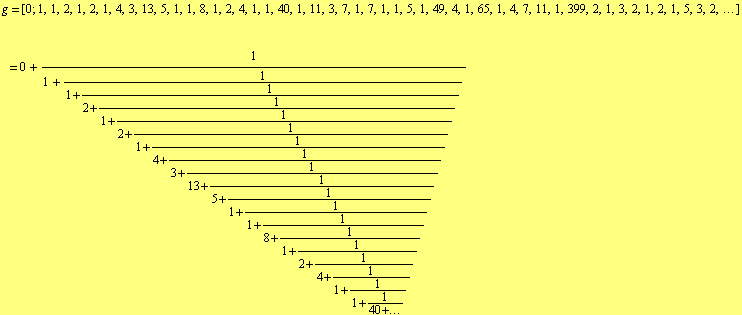
The first 20 convergents are

To see the order of the approximation of a convergent go to .
A reasonable approximation of  is given by the formula
 | (4) |
Frederick W. Odena [10] gave another curious approximation
 | (5) |
D. Castellanos [11] gave these approximations

In 1874 Mertens [12] proved that
![e^γ/(ln x) ~ Underscript[∏, p <= x] (1 - 1/p) , as x -> ∞ ,](HTMLFiles/EulerMascheroni_54.gif)
where the sum runs over all primes  , or in another form
![Underscript[lim, n -> ∞] 1/p _ n Underoverscript[∏, k = 1, arg3] (1 - 1/p _ n)^(-1) = e^γ,](HTMLFiles/EulerMascheroni_56.gif) | (6) |
where  is the
  th prime. This gives an alternate expression for
![γ = Underscript[lim, x -> ∞] ( Underscript[∑, p <= x] ln p/(p - 1) - ln ln x) ,](HTMLFiles/EulerMascheroni_60.gif)
where  runs over the all primes.
Another amusing appearance of γ in number theory shows the following result due to de la Vallée Poussin in 1898:
If a large positive integer  is divided by each positive integer
  , then the average fraction by which the quotient
  falls short of the next integer is
  . In other words
![Underscript[lim, n -> ∞] 1/n Underoverscript[∑, k = 1, arg3] {n/k} = 1 - γ ,](HTMLFiles/EulerMascheroni_66.gif)
Here  denotes the fractional part.
In 1838 Dirichlet proved that
![Underoverscript[∑, k = 1, arg3] d(k) = n log n + (2 γ - 1) n + O(n^(1/2))](HTMLFiles/EulerMascheroni_68.gif)
where  denotes the divisor function counting the number of positive divisors of
  .
.
Euler gave two zeta-function series expressions for 
![γ = Underoverscript[∑, k = 2, arg3] (k - 1)/k (ζ(k) - 1) = 1 - Underoverscript[∑, k = 2, arg3] (ζ(k) - 1)/k ,](HTMLFiles/EulerMascheroni_72.gif) | (7) |
![γ = Underoverscript[∑, k = 2, arg3] (-1)^k ζ(k)/k,](HTMLFiles/EulerMascheroni_73.gif) | (8) |
where  is the Riemann zeta function. We also have
![γ = Underscript[lim, s -> 1] (ζ(s) - 1)/(s - 1) .](HTMLFiles/EulerMascheroni_75.gif)
Since the expressions involve the Riemann zeta function they are convenient for computational purposes. Glaisher [13] proved a number of formulas of the type
![γ = 1 - Underoverscript[∑, k = 1, arg3] ζ(2 k + 1)/((k + 1) (2 k + 1)) .](HTMLFiles/EulerMascheroni_76.gif)
Ramanujan [14] proved a general formula verifying a Glaisher’s conjecture (ibid. 44, pp. 1-10) about the existence of a general formula of the type
![γ = λ _ r - Underoverscript[∑, k = 1, arg3] ((r + 1) (r + 2) ...(r + 2 k))/((2 k + 1) (2 r + 1) (2 r + 2) ...(2 r + 2 k)) ζ(2 k + 1),](HTMLFiles/EulerMascheroni_77.gif)
for arbitrary positive integer  where
where  is a rational number. Ramanujan proved that
![γ = Underoverscript[∫, 0, arg3] (1 + x^(2 r - 1))/(1 + x) d x - Underoverscript[&# ... g3] ((r + 1) (r + 2) ...(r + 2 k))/((2 k + 1) (2 r + 1) (2 r + 2) ...(2 r + 2 k)) ζ(2 k + 1),](HTMLFiles/EulerMascheroni_80.gif)
for every  . This implies that
  if
if  is integral.
Euler-Mascheroni constant occurs in many formulas involving Gamma function, for instance  .
.
The definition of  can be extended in many way. One of them says [15]
![γ = Underscript[lim, n -> ∞] [(2^m/1 + 3^m/2 + ... + n^m/(n - 1)) + m - (S _ n^0 + S _ n^1 + ... + S _ n^(m - 1)) - ln(n - 1)],](HTMLFiles/EulerMascheroni_86.gif)
where  . If
. If  we get the original definition.
Boas [16] studied an analog of Euler-Mascheroni constant defined by
![Underscript[lim , n -> ∞] (Underoverscript[∑, k = 1, arg3] f(k) - ∫ _ 1^n f(x) d x) .](HTMLFiles/EulerMascheroni_89.gif) | (9) |
| 1 | It is not known whether  is irrational. G. H. Hardy is said to have offered to give up his Savilian Chair at Oxford to person who proves that is irrational. G. H. Hardy is said to have offered to give up his Savilian Chair at Oxford to person who proves that  is irrational. Hilbert even said that the irrationality of is irrational. Hilbert even said that the irrationality of  as an unsolved problem seems unapproachable. as an unsolved problem seems unapproachable. |
| [1] | Dirichlet, G. L. (1836). Sur les intégrales eulériennes. J. reine angew. Math., 15, 258-263 (Werke Vol. I, pp. 273-282, G.Reimer, Berlin 1889) . |
| [2] | Euler, L. (1735). De Progressionibus harmonicus observationes. Commentarii Academiæ Scientarum Imperialis Petropolitanæ , 7-1734, 150-160. |
| [3] | Glaisher, J. W. (1871). On the history of Euler's constant. Messenger (2), I, 25-30. |
| [4] | Adams, J. C. (1878). Table of the values of the first sixty-two numbers of Bernoulli. J. reine angew. Math., 85, 269-272. |
| [5] | Ohm, M. (1840). Etwas über die Bernoullischen Zahlen. J. reine angew. Math., 20, 11-12. |
| [6] | Mascheroni, L. (1790, 1792). Adnotationes ad calculum integralem Euleri, Vol. 1 and 2. . Ticino, Italy (Reprinted in Euler, L. Leonhardi Euleri Opera Omnia, Ser. 1, Vol. 12. Leipzig, Germany: Teubner, pp. 415-542, 1915.). |
| [7] | Sweeney, D. W. (1963, March 14). On the Computation of Euler's Constant. Math. Comput., 17(3), 170-178. |
| [8] | Brent, R. P., & McMillan, E. M. (1980). Some new algorithms for high-precision computation of Euler's constant. Math. Comput. , 34, 305-312. |
| [9] | Conway, J. H., & Guy, R. K. (1996). The Euler-Mascheroni Number. In . <Last> (Ed.), The Book of Numbers. (pp. 260-261). Berlin: Springer Verlag. |
| [10] | Odena, F. W. (1982/1983).. J. Recreational Math., 15(2), 118. |
| [11] | Castellanos, D. (1988). The ubiquitous π. Math. Mag., 61(2), 67-97. |
| [12] | Mertens, F. (1874). Ein Beitrag zur analytischen Zahlentheorie. Über die Verteilung der Primzahlen.. J. riene angew. Math., 78, 46-63. |
| [13] | Glaisher, J. W. (1914). Relations connecting quantities of the form  . Messenger, 44, 1-10. . Messenger, 44, 1-10. |
| [14] | Ramanujan, S. (1916). A series for Euler’s constant  . Messenger, 46, 73-80. . Messenger, 46, 73-80. |
| [15] | (1984, Nov.). Problem 1204. Math. Magazine, 57(5), 298 (solution ibid. 58, No. 5. (Nov., 1985), 302 ). |
| [16] | Boas, R. P. (1977). Partial sums of infinite series, and how they grow. Amer. Math. Monthly, 84, 237-258. |
Cite this web-page as:
Štefan Porubský: Euler-Mascheroni Constant.