 Main Index
 Mathematical analysis
Infinite series and products
Infinite products
Mathematical analysis
Infinite series and products
Infinite products
 Subject Index
 comment on the page
Main Index
Mathematical analysis
Infinite series and products
Infinite products
Subject Index
comment on the page
Infinite product appeared for the first time [1] in the work of Viète [2] , p. 400, who found  the product involving

Almost simultaneously in 1656 J.Wallis [3] , p. 468, found the expression
![π/2 = 2/1 2/3 4/3 4/5 6/7 6/7 ... = Underoverscript[∏, n = 1, arg3] (4 n^2)/(4 n^2 - 1) .](HTMLFiles/InfiniteProducts_3.gif)
Euler later found many infinite product expressions, but the rigorous convergence theory of infinite products was initiated by Cauchy.
An infinite product is an expression of the form
![Underoverscript[∏, n = 1, arg3] u _ n = u _ 1 u _ 2 u _ 3 ...](HTMLFiles/InfiniteProducts_4.gif)
This infinite product is called convergent
 such that
  for all
  ,
, of partial products
  converges to a non-vanishing limit, say
  .
.Otherwise the product is said to diverge. If both conditions are satisfied the product is assigned the value  . Because of the first condition it is often used the notation
  indicating that it is sufficient to consider the products only from some index onwards. For the sake of simplicity, in what follows we shall always start with
  .
.
There follows from the definition that a convergent infinite product vanishes if and only if on of its factors vanishes.
Theorem: If an infinite product converges then  ..
..
Previous result motivates to denote the factors of an infinite product in the form  , where if the product is convergent we can suppose that
  , that is to consider the products of the type
![Underoverscript[∏, n = 1, arg3] (1 + a _ n) .](HTMLFiles/InfiniteProducts_17.gif) | (1) |
Theorem (Cauchy-Bolzano criterion): The infinite product  converges if and only if for every
  there exists
  such that for every
  and every
  we have

Theorem: The infinite product  converges if and only if the series
  converges for some
  (here we take the principal branch of the logarithm).
Proof. Without loss of generality we can suppose that  . Let
. Let  , and
, and  be the
  th partial sum of the infinite series and
  the
the  th product of the infinite product, respectively. Then
  .
.
Suppose that the series converges and let  . Then by continuity

and the Theorem is proved in one direction.
In the opposite direction the problem is caused by the fact that  does not converge to
  but to one of its branches.
For every  there is an integer
  such that
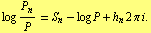
Taking the difference we get

and thus for the arguments we have

Since  , l
, l as
as  . Thus the first two terms on the right hand side are approaching each other, while the absolute values of the last term is at most
  . Consequently,
  for all sufficiently large
  , and the series converges.
An infinite product  is called absolutely convergent if the product
  is convergent.
Theorem: The product  converges absolutely if and only if the series
  converges absolutely.
Theorem: If the product  converges then also the product
  converges.
Theorem: The product  converges absolutely if the series
  converges and the series
  converges absolutely.
Note that if  and if
  converges then clearly it converges absolutely, but this is not true for complex
  .
.
Theorem: If the series  converges absolutely and if for
  we have
  , then
![lim _ (n -> ∞) (Underoverscript[∏, k = n _ 0 + 1, arg3] (1 + a _ k))/exp(Underoverscript[∑, k = n _ 0 + 1, arg3] a _ k)](HTMLFiles/InfiniteProducts_58.gif)
exists and is finite and non-vanishing.
Note that the previous result does not depend on the convergence behavior of the series  .
.
To the proof note that  , that is
![(1 + a _ (n _ 0 + 1)) (1 + a _ (n _ 0 + 2)) ...(1 + a _ n) = Underoverscript[∏, k = n _ ... #8721;, k = n _ 0, arg3] a _ k) e^(Underoverscript[∑, k = n _ 0, arg3] ϑ _ k a _ k^2) .](HTMLFiles/InfiniteProducts_61.gif)
Since the  ’s are bounded, the exponent in the second factor converges, and the Theorem follows.
Corollary: If the series  converges absolutely, the series
  and the product
  have the same convergence behavior.
If in (1) the numbers  are non-negative, the product is called with non-negative terms.
Theorem: The product  with
with  converges if and only if the series
  converges.
Theorem: The product  with
with  converges if and only if the series
  converges.
The products  and
and  are convergent for
  and divergent for
  .
.
If  then
then  monotonically decreases and consequently converges. If in addition
  diverges the
  , and the product
  diverges to 0.
| [1] | Knopp, K. (1996). Theorie und Anwendung der unendlichen Reihen. (Theory and applications of infinite series).6th ed.. Berlin: Springer Verlag. |
| [2] | Viète, F. (1646). Opera Mathematica. Leyden; reprinted London, 1970 |
| [3] | Wallis, J. (1695). Opera I. Osord |
Cite this web-page as:
Štefan Porubský: Infinite products.