 Main Index
 Mathematical Analysis
Inequalities
Mathematical Analysis
Inequalities
 Subject Index
 comment on the page
Main Index
Mathematical Analysis
Inequalities
Subject Index
comment on the page
There are three Pythagorean means:
 by
by 
 by
by 
 by
by 

For  we have

and 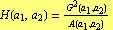 . Note that
  is the arithmetic mean of
  and
and  . For instance, every term
  ,
,  , of the harmonic series
  is the harmonic mean of the neighboring terms.
Pappus [2] , Book III (12-16, p. 70-83) defines these means [1] in modern notation as follows:
 is the arithmetic mean of
  and
and 
 if
if  , or
, or  ,
, is the geometric mean of
  and
and  if
if  , or
, or  ,
, is the harmonic mean of
  and
and  if
if  .
.Geometric mean  of two numbers
  is also called mean proportional because it can expressed as the means of a proportion
  . Its construction is described in Euclid’s Elements. Proposition VI.13 of Book VI requires: To given straight lines to find a mean proportional. The construction goes as follows. Place two given segments
  and
and  in a straight line and draw the semicircle with diameter
  . Let
. Let  be the perpendicular to
  . Then using Proposition VI.8 2 one gets
  .
.
![[Graphics:HTMLFiles/PythagoreanMeans_41.gif]](HTMLFiles/PythagoreanMeans_41.gif)
This gives the following geometric construction for the arithmetic and geometric means and the geometric proof that  .
.
![[Graphics:HTMLFiles/PythagoreanMeans_49.gif]](HTMLFiles/PythagoreanMeans_49.gif)
Pappus gives the following construction: the length of  is the geometric mean of lengths
  and
and  .
.
![[Graphics:HTMLFiles/PythagoreanMeans_53.gif]](HTMLFiles/PythagoreanMeans_53.gif)
In Book III he gives the following construction for the harmonic mean: Given two segments  ,
,  ,
,  , on a line mark off
  on the perpendicular to
  at
at  . Let
. Let  be the intersection of
  with the perpendicular to
  at
at  . Draw
  to cut
  in
in  . Then
  is the harmonic mean of the given segments
  and
and  .
.
![[Graphics:HTMLFiles/PythagoreanMeans_73.gif]](HTMLFiles/PythagoreanMeans_73.gif)
Geometric construction of all three Pythagorean means can also be found in [3] , Book III, p. 51: Take a semi-circle of centre  and diameter
  . Let
. Let  and
and  . Then
  . Construct the right angle
  . Then
  . Since the shortest distance is the perpendicular distance,
  , with equality only if
  . Clearly
  . If
. If  is perpendicular to
  , then
  . By the same argument
  with equality if and only if
  .
.
![[Graphics:HTMLFiles/PythagoreanMeans_92.gif]](HTMLFiles/PythagoreanMeans_92.gif)
Another simple construction is [4], p.38: Let  be trapezium be with two parallel sides
  and
and  . Then
 is parallel to
  and bisects
  and
and  , then the length of
  equals
  .,
., is parallel to
  and divides
  into two similar trapezia, then the length of
  equals
  ,
, is parallel to
  then the length of
  equals
  .
.
![[Graphics:HTMLFiles/PythagoreanMeans_114.gif]](HTMLFiles/PythagoreanMeans_114.gif)
In general we have

with equality holding if and only if  .
.
Clearly,

and the means are homogeneous, that is for  we have

If  then
then 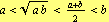 . If we define
  , then it follows that the iterations
  converge to a single number called arithmetic-geometric mean of
  . Formally, the arithmetic-geometric mean iteration is defined by the following recursion: Let
  and
and

Then  and
and 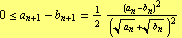 . This shows that
  and
and  converge to a common limit
  .
.
We also have

We can also define the harmonic-geometric mean iteration by

If  then this iteration converges and

Finally, the arithmetic-harmonic mean iteration is defined by

If  then this iteration converges to the geometric mean of
  and
and  , i.e.

| 1 | The name harmonic mean was introduced by Hippas of Metapont (ca. 450 BC), cf. [1] ,p. 243. |
| 2 | If in a right-angled triangle a perpendicular is drawn from the right angle to the base, the triangles adjoining the perpendicular are similar both to the whole and one another. |
| [1] | Gericke, H. (2004). Mathematik in Antike, Orient und Abendland. Wiesbaden: Fourier Verlag GmBH. |
| [2] | Pappi Alexandrini. (1875-1878). Collectiones quae supersunt (ed. F. Hultsch) 3 Vols.. Berlin (reprint Amsterdam: Hakkert 1965). |
| [3] | Pappus d’Alexandrie. (1933). La Collection Mathématique (French transl. and comments P. ver Ecke). Paris: Brügge. |
| [4] | Bullen, P. S., Mitrinović, D. S., & Vasić, P. M. (1988). Means and Their Inequalities. Dordrecht, Boston, Lancaster, Tokyo: D.Reidel a Publishing Company. |
Cite this web-page as:
Štefan Porubský: Pythagorean Means.